
The morning a parade lines up is the one you cannot improvise.
Lanes, order, staging lengths, and step-off times on one board. Give an entry a lane that cannot hold it and Karsenics refuses, and tells you the room actually left. Lock the order and the signs print from the same board you have been working all along.
Join Early Access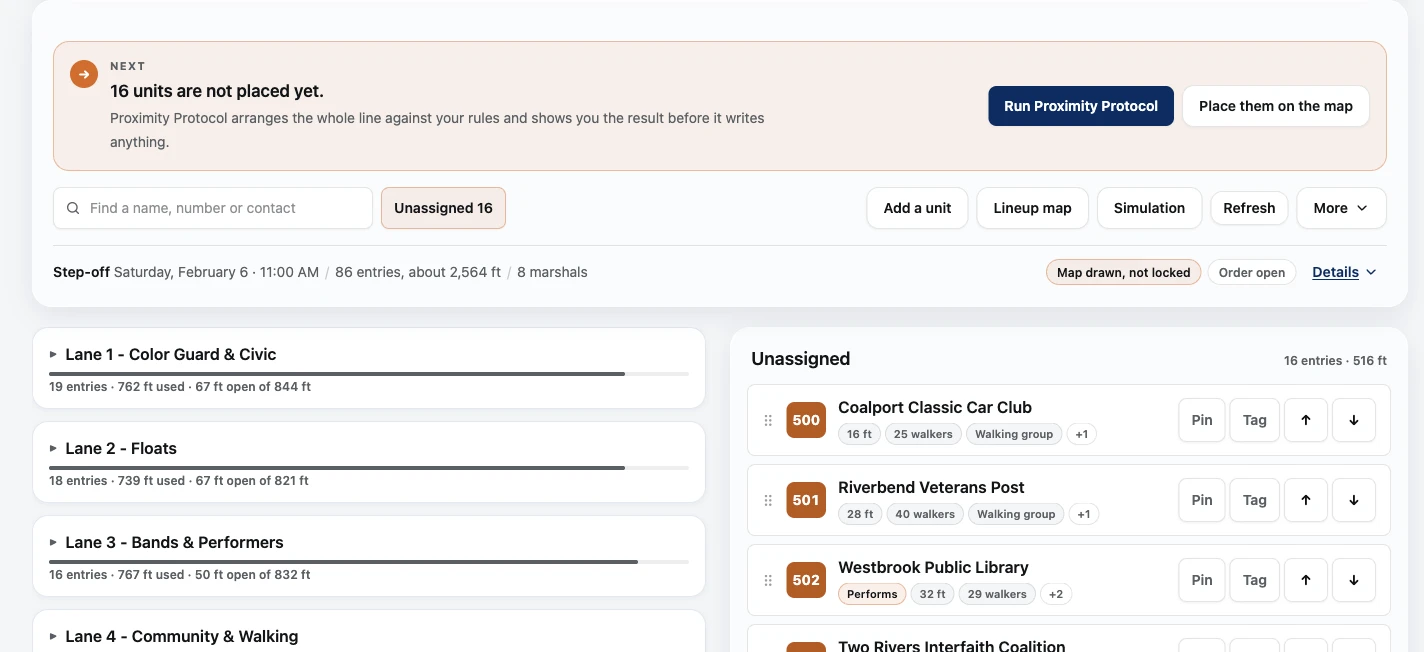
A lineup checked before anyone steps off.
Two short films of the real product, with demonstration data. No sound needed.
Then watch the line leave staging.
The simulation runs your lineup down your own route, lane by lane in the order you set, so you see the timing and the gaps before the street closes.
A festival can absorb a late vendor. A parade cannot absorb a float that does not fit.
The lineup is arithmetic done under time pressure, usually the night before, usually in a spreadsheet, and the mistakes only show up once the street is closed and the units are already rolling in. Karsenics does that arithmetic while there is still time to fix it, and refuses the assignments that were never going to work.
- Lineups built by hand the night before
- A float that measured 40 feet turning up at 90
- Signs printed, then three entries drop and two more arrive
- Nobody at the gate knowing who is cleared to roll
Built by people who have stood in the staging area at 6am.
Lanes that know their limit
Give an entry a lane that cannot hold it and Karsenics refuses, and names the room actually left. You can overrule it, and an entry you overruled is never moved again on its own.
Capacity that counts the gaps
A lane's capacity counts the space between entries, not just the entries themselves, so the number means the road you actually have.
Two lengths, not one
Staging length drives the lanes and the signs. Parade length drives the timing along the route. One number doing both jobs is wrong for every float.
Arrange it in one pass
Auto-arrange assigns lanes and order under the rules you set, shows you a preview, and saves nothing until you apply it. Pinned entries stay where you put them.
Printed signs stay true
Once the order is locked, a late arrival slots in without renumbering anybody, so the signs you already printed do not quietly become wrong.
A real gate, not a clipboard
Crew unlock their station with the event's PIN and their first name, and every arrival shows what that entry still owes.
Staging room and road room are different numbers.
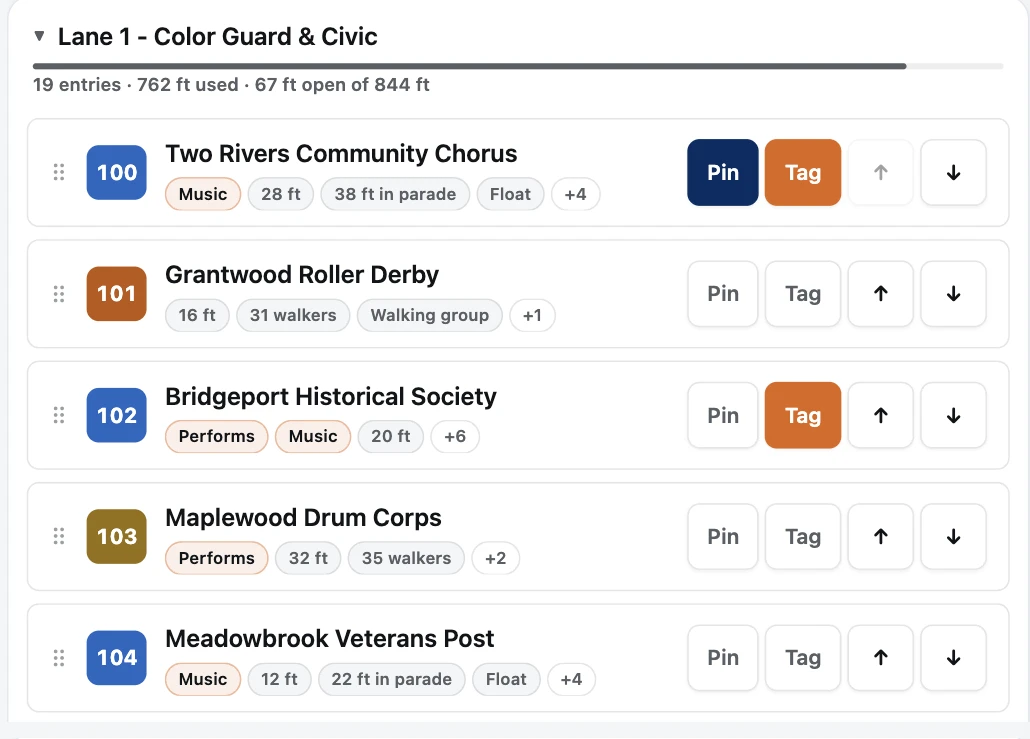
The application asks how much room an entry needs while it waits and how much road it takes once it is moving. Staging length fills the lanes. Parade length drives the timing. Every lane shows what it holds and what is still open.
- Each lane shows entries, feet used and feet still open, counting the gap between units
- Every entry carries its facts as chips: length, walkers, music, performs
- Correct a unit's length on the board when a 40-foot float shows up at 90
- Pin an entry and auto-arrange leaves it exactly where you put it
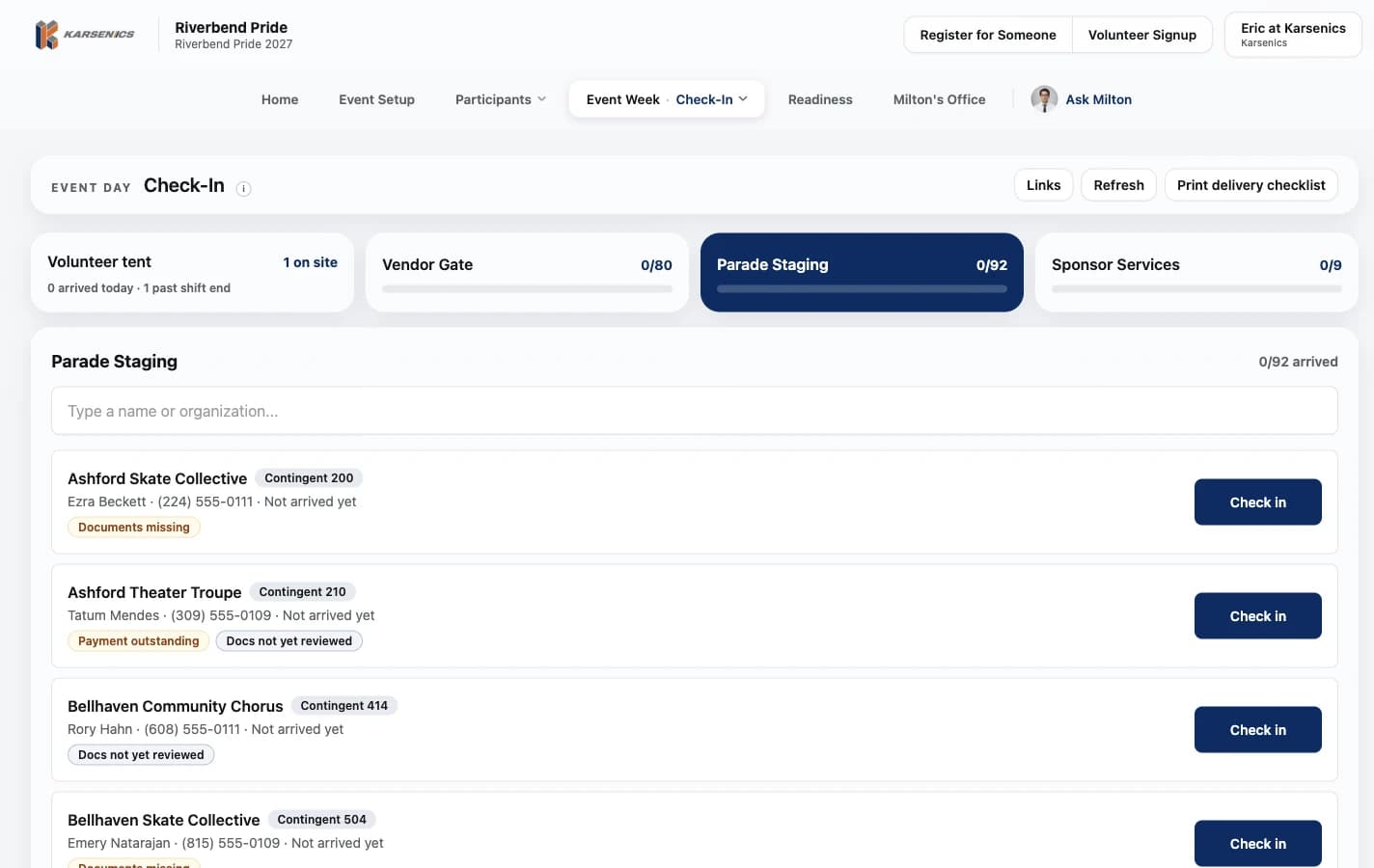
Staging check-in on a phone, not a clipboard.
Parade Staging is its own station at check-in. Crew search by name or contingent number, see who is still missing documents or payment, and check units in as they arrive.
- Each station counts arrivals against its total
- Unlocked with the event's gate PIN and the crew member's first name
- Keeps checking people in when the signal drops, and syncs when it comes back
Ready to stop building the lineup by hand?
Let's walk through your staging area and see what the board would look like.